Posts

How is White mineral Oil Different from other oils?
Image
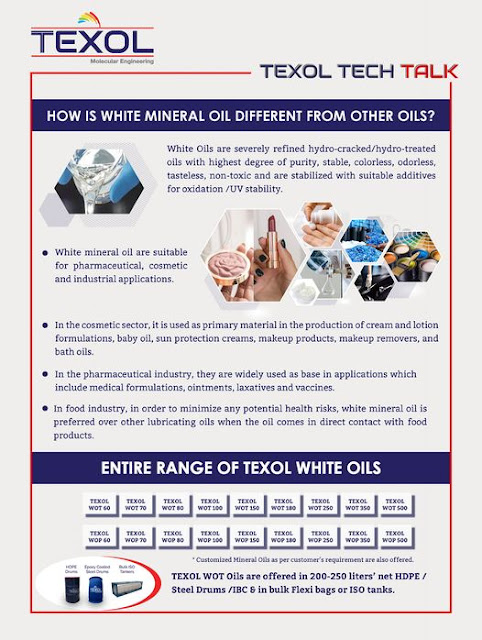
  Mineral oil is a widely used ingredient in a wide range of industries, from cosmetic and personal-care manufacturing to mechanical work and engineering. The term "mineral oil" is frequently used in a broad sense, referring to a variety of petroleum-based oils. The refining process produces mineral oil. White mineral oil is a highly refined petroleum mineral oil composed of a complex mixture of hydrocarbons obtained through intensive treatment of a petroleum fraction with sulfuric acid and oleum, hydrogenation, or a combination of hydrogenation and acid treatment. Engine oils are available in a range of grades, viscosities, and additives. It is difficult to decide whether to buy mineral oil or synthetic oil for the engine. In general, conventional oil outperforms mineral oil in areas such as vehicle protection and lubrication addition. Whereas, white mineral oils are used in a variety of applications across a wide range of industries. White mineral oil is also referred to as...
What is the shelf life of lubricants and greases?

Image
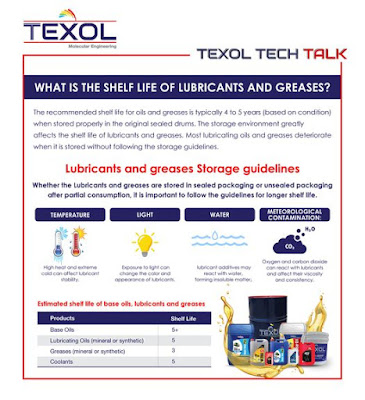
  A product’s shelf life is described as “the amount of time a commodity may be stored until it becomes unfit for use, consumption, or sale.” It’s important to remember that manufacturers assess a product’s shelf life based on normal usage and storage expectations. When handled properly in their initial sealed containers, oils and greases have a five-year shelf life. If recommended recommendations are not followed, the estimated shelf life can be shortened. The majority of products, including lubricating greases, degrade over time. The degree of oxidation of lubricating greases is highly dependent on storage conditions. A lubricating grease’s shelf life can be extremely long if stored properly. Storage Tips : Lubricants may change their appearance and/or color when exposed to light, so keep them in a dark place. Water penetration in sealed, opaque containers may encourage microbial growth and affect certain additives, resulting in the formation of insoluble material. Never store in...

What causes engine oil degradation?

Image
  Automotive engines are being engineered to be more dynamic, quicker, and powerful as technology advances. However, these advancements come with their collection of problems, the most serious of which is oil degradation. Many types of equipment failures may be caused by fluid deterioration. A lubricant in use is exposed to a variety of conditions that can degrade it. Here are some causes of engine oil degradation :  Oxidation: The reaction of oil molecules with oxygen molecules is known as oxidation. It may cause viscosity to rise. Also, there will be the formation of varnish, sludge, and sediment. Additive degradation and base oil breakdown are also possible outcomes. You will notice a rise in the acid number when an oil begins to oxidize. Furthermore, oxidation can cause rust and corrosion on the equipment. Thermal Breakdown: One of a lubricant's key problems is the thermal breakdown. The temperature of a lubricant is one of the most important things that one should conside...

Everything you wanted to know about automotive Lubricants

Image
  Lubricants play a major role in controlling the friction in the engine. They protect the engine from rusting and help in cooling the pistons. They also protect the engine oil stored from combustion gases. They broadly fall into two categories - monograde and multigrade – depending on whether their viscosity changes significantly with temperature or not. The viscosity grade of a multigrade oil is different at high and low temperatures due to additives known as viscosity modifiers. Lubricants are remarkable fluids and essential in modern life.  To have a better running of car engines and gearboxes, the oil and greases should be good. Most of the lubricants are petrol-based. It is necessary to change your oil as per the schedule to avoid contamination of oil. Proper lubrication provides the best protection. It is very useful to clean and prevent metal parts from corrosion and rust. It maximizes your engine’s life and reduces vehicular emissions. Lubricating oil should be change...

Brief on Industrial Specialty Oils

  Industrial specialty oil has different properties and it includes physical, chemical properties or the structure, quality value. A lot of industrial specialty oils are made for high safety protection as it provides better results, and the demand is increasing for the same. Increasing application of specialty oils like inks oils, cleaning agents, cement mould oils, etc. boosts the demand for the oil as it has unique functional properties. Here are different ranges of Industrial Specialty oils which will give you a broader perspective of its benefits: Fire Resistant Hydraulic Oils: In industrial systems, it may encounter sparks, flame, or any nearby equipment that is there. They are associated with hydraulic systems. The most important parameter, while you use the fire-resistant fluid, is to assess the operating temperature. It will help in lowering the risk and also reduce the need for a fire-suppression system. Rust Preventives (Oil-based, Dry film, De-watering type):  This...

Transformer Oil Testing Methods for quality assurance

  Oil plays a significant and critical role in keeping the transformers running efficiently. It is also known as insulating oil and serves as liquid insulation in electrical equipment and also vanishes heat from such equipment. It can be said that it is a lifesaver for any equipment because it avoids any type of oxidation. A transformer is a key element of the power grid for efficient electricity distribution with minimal energy loss. A transformer can also be a failure and negatively affect the electricity grid system which can result in accidents and financial damage. The best quality oil must be used by using the testing method to ensure it is of good quality. Transformer Oil acts as a barrier between the atmospheric oxygen and the cellulose to avoid direct contact. The level of oil is measured by Magnetic Oil Level Gauge (MOG). Transformer oil testing methods prove to be loss prevention which is good to take precautionary measures. It helps us to improve the maintenance, order ...

Difference between Synthetic oil & Mineral oil

  It is a known fact that engine oils play a vital role to make engines perform to their best. Motor oil is used to lubricate engine parts and decrease friction, but before filling your oil tank, it is important to choose the right oil, especially prior to the first fill. There are two main types of motor oils: mineral oils and synthetic oils. Mineral oils are derived from the refining of crude petroleum. During the process, natural contaminants and unwanted hydrocarbons are removed. Mineral oils are ideal for older vehicle models that were developed to run on less technologically advanced lubricants; a reason why they’re also a low-cost option for fleet managers and motorists. However, mineral oils do flow through engine circuits slower than synthetic oils, which can result in increased fuel consumption and impacted vehicle performance. Mineral oils also need to be changed more frequently than synthetic oils. However, if they are recommended by your automotive manufacturer, minera...