Posts

Showing posts with the label oil factory

Evaluation of turbine oil performance using TOST

Image
  Turbines are rotating prime movers in which the energy of a fluid is converted into mechanical energy, which is then used to generate electricity. The most commonly used fluids are steam, hot gases produced directly from burning fuel, and water. Turbine oil must lubricate the shaft bearings, remove heat, operate the servomechanisms of regulating valves, and, if present, lubricate the gear reduction units. End-users of turbine oil expressed their greatest concern as unplanned downtime during turbine operation. If a power company is unable to provide power, the cost of downtime can be significant. Today's turbine systems operate under increasingly harsh conditions, including wider temperature variations. Temperature fluctuations in turbine oil can cause oxidation and thermal degradation, which is caused by the oil's elevated temperatures. The physical and chemical properties of lube oil, as well as common contaminants such as water and solid particles, must be carefully monitor...
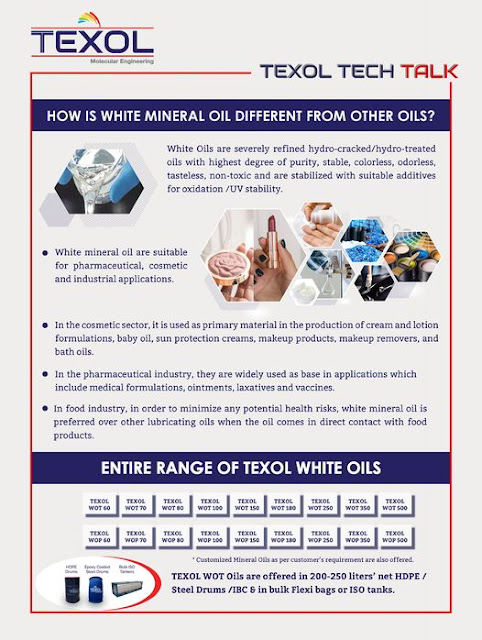
How is White mineral Oil Different from other oils?

Image
  Mineral oil is a widely used ingredient in a wide range of industries, from cosmetic and personal-care manufacturing to mechanical work and engineering. The term "mineral oil" is frequently used in a broad sense, referring to a variety of petroleum-based oils. The refining process produces mineral oil. White mineral oil is a highly refined petroleum mineral oil composed of a complex mixture of hydrocarbons obtained through intensive treatment of a petroleum fraction with sulfuric acid and oleum, hydrogenation, or a combination of hydrogenation and acid treatment. Engine oils are available in a range of grades, viscosities, and additives. It is difficult to decide whether to buy mineral oil or synthetic oil for the engine. In general, conventional oil outperforms mineral oil in areas such as vehicle protection and lubrication addition. Whereas, white mineral oils are used in a variety of applications across a wide range of industries. White mineral oil is also referred to as...

What causes engine oil degradation?

Image
  Automotive engines are being engineered to be more dynamic, quicker, and powerful as technology advances. However, these advancements come with their collection of problems, the most serious of which is oil degradation. Many types of equipment failures may be caused by fluid deterioration. A lubricant in use is exposed to a variety of conditions that can degrade it. Here are some causes of engine oil degradation :  Oxidation: The reaction of oil molecules with oxygen molecules is known as oxidation. It may cause viscosity to rise. Also, there will be the formation of varnish, sludge, and sediment. Additive degradation and base oil breakdown are also possible outcomes. You will notice a rise in the acid number when an oil begins to oxidize. Furthermore, oxidation can cause rust and corrosion on the equipment. Thermal Breakdown: One of a lubricant's key problems is the thermal breakdown. The temperature of a lubricant is one of the most important things that one should conside...

Everything you wanted to know about automotive Lubricants

Image
  Lubricants play a major role in controlling the friction in the engine. They protect the engine from rusting and help in cooling the pistons. They also protect the engine oil stored from combustion gases. They broadly fall into two categories - monograde and multigrade – depending on whether their viscosity changes significantly with temperature or not. The viscosity grade of a multigrade oil is different at high and low temperatures due to additives known as viscosity modifiers. Lubricants are remarkable fluids and essential in modern life.  To have a better running of car engines and gearboxes, the oil and greases should be good. Most of the lubricants are petrol-based. It is necessary to change your oil as per the schedule to avoid contamination of oil. Proper lubrication provides the best protection. It is very useful to clean and prevent metal parts from corrosion and rust. It maximizes your engine’s life and reduces vehicular emissions. Lubricating oil should be change...

How can I make my hydraulic system more efficient?

Image
  Hydraulic efficiency as far as water-powered liquid relies upon a couple of variables, all of which identity with the thickness of the water-driven liquid. Low thickness, either from helpless liquid choice or high temperatures, brings about lost volumetric effectiveness, overheating, and wear. It’s a well-known fact that the force hotspot for machine movement can incredibly affect the measure of vitality a machine expends. The customary way of thinking holds that electric drives are more effective than their liquid force partners. In any case, for specific assignments, power through pressure holds the advantage. Hardware with solitary, controllable water-driven siphon and collector can devour less force than electric engines and gearboxes in applications with a great deal of to and fro movement, that move or hold hefty burdens, or that have an enormous number of movement tomahawks. Picking a multi-grade water-powered liquid with a high consistency record will correspond to pr...

What are the uses of paraffin oil?

Image
  Paraffin, otherwise called fluid paraffin, paraffin oil or lamp oil, is an ignitable hydrocarbon fluid that is scorched as a fuel. It is a blend of various kinds of straightforward hydrocarbons, it is less unpredictable than fuel and it bubbles at 302-527 degrees Fahrenheit. The expense of creating paraffin was high, be that as it may, when new wellsprings of paraffin and less expensive techniques for refining were later found, it leads to bring down costs of the fuel. Paraffin, when found in strong structure, is called paraffin wax, while the fluid structure is alluded to as paraffin oil. Fluid paraffin oil is a mineral oil that comes in two structures, either overwhelming fluid paraffin oil or light fluid paraffin oil. Paraffin is perfect consuming and keeps up a high warmth yield. It is known for alleviating dried out hands from teasing, soothing joints from hurting and preventing other difficult skin illnesses from easing back you down. Its greasing up properties are additi...

Function of Lubricating Oil

Image
The function of lubricating oils or ointments are attempted to be gotten from when people utilized instruments. Greasing up oil has been utilized for an assortment of purposes to forestall contact and erosion on the conflicting surfaces, smother heat age, keep protests clean, and make protection and rust-preventive impacts. To know more, you can always get in touch with oil companies in UAE . The basic role of oil is to lessen wear and warmth between reaching surfaces in relative movement. While wear and warmth can't be totally disposed of, they can be decreased to irrelevant or satisfactory levels. Since warmth and wear are related with grinding, the two impacts can be limited by decreasing the coefficient of erosion between the reaching surfaces. Oil is additionally used to decrease oxidation and forestall rust; to give protection in transformer applications; to transmit mechanical force in pressure-driven liquid force applications; and to seal against residue, earth, a...