Posts

Showing posts with the label lubricating greases

What is the shelf life of lubricants and greases?
Image
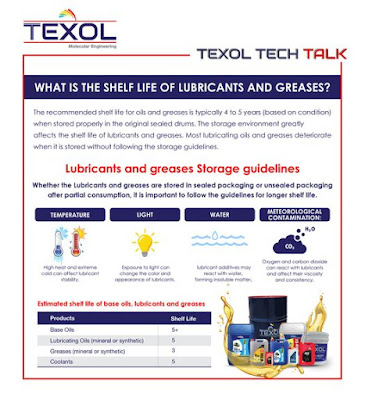
  A product’s shelf life is described as “the amount of time a commodity may be stored until it becomes unfit for use, consumption, or sale.” It’s important to remember that manufacturers assess a product’s shelf life based on normal usage and storage expectations. When handled properly in their initial sealed containers, oils and greases have a five-year shelf life. If recommended recommendations are not followed, the estimated shelf life can be shortened. The majority of products, including lubricating greases, degrade over time. The degree of oxidation of lubricating greases is highly dependent on storage conditions. A lubricating grease’s shelf life can be extremely long if stored properly. Storage Tips : Lubricants may change their appearance and/or color when exposed to light, so keep them in a dark place. Water penetration in sealed, opaque containers may encourage microbial growth and affect certain additives, resulting in the formation of insoluble material. Never store in...

Everything you wanted to know about automotive Lubricants

Image
  Lubricants play a major role in controlling the friction in the engine. They protect the engine from rusting and help in cooling the pistons. They also protect the engine oil stored from combustion gases. They broadly fall into two categories - monograde and multigrade – depending on whether their viscosity changes significantly with temperature or not. The viscosity grade of a multigrade oil is different at high and low temperatures due to additives known as viscosity modifiers. Lubricants are remarkable fluids and essential in modern life.  To have a better running of car engines and gearboxes, the oil and greases should be good. Most of the lubricants are petrol-based. It is necessary to change your oil as per the schedule to avoid contamination of oil. Proper lubrication provides the best protection. It is very useful to clean and prevent metal parts from corrosion and rust. It maximizes your engine’s life and reduces vehicular emissions. Lubricating oil should be change...

What Industry Dominates Lubricant Consumption?

Image
Automotive lubricants dominate the global lube consumption. Automotive lubricants accounts ~ 55% of the global lubricants market and the demand for high-quality lube is expected to create significant opportunities over the long-term forecast period. In terms of consumption, over 60 percent of the energy is consumed in the vehicle through the engine components. So improvements in automotive lubricants is the ideal place to optimize the performance of engines. High-performance automotive lubricants constitute excellent solvency and better hydrophilic properties. Application of these automotive lubricants leads to durable operation of the engine through lighter viscosity grades of high-performance lubricants. Additionally, less viscous and premium synthetics lubricants also increase the fuel economy of engines to a greater extent. In recent years, nano-lubricants have been an advanced development in the market of automotive lubricants, created by adding nanoparticles to lube oils. Adding ...

Understanding Lubricating Greases

Image
  You can develop the perfect machine that delivers exactly the right performance at high speed and low cost, but if you fail to make the right choice of the lubricant, that perfect machine will die an early death. Properly specified and maintained, lubrication is the single most straightforward way for OEMs and end-users alike to ensure top performance and lifetime for a machine. All too often, however, lubrication gets pushed aside for other, seemingly more important tasks. Lubrication is a process that aims at reducing friction between two moving pieces. When two surfaces come in contact with one another, the fluid must be injected to separate them. The word greasing applies when grease is used to lubricate. Lubricating grease is a mixture of three main components: lubricating fluid, performance-enhancing additives, and thickener. The lubricating fluid can be petroleum-derived lubricating oil, any of various synthetic lubricating fluids, or vegetable-based oil. The lubricating f...