Posts

Showing posts with the label automobiles

What is the shelf life of lubricants and greases?
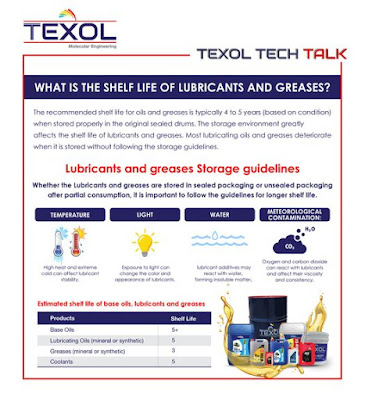
Image
  A product’s shelf life is described as “the amount of time a commodity may be stored until it becomes unfit for use, consumption, or sale.” It’s important to remember that manufacturers assess a product’s shelf life based on normal usage and storage expectations. When handled properly in their initial sealed containers, oils and greases have a five-year shelf life. If recommended recommendations are not followed, the estimated shelf life can be shortened. The majority of products, including lubricating greases, degrade over time. The degree of oxidation of lubricating greases is highly dependent on storage conditions. A lubricating grease’s shelf life can be extremely long if stored properly. Storage Tips : Lubricants may change their appearance and/or color when exposed to light, so keep them in a dark place. Water penetration in sealed, opaque containers may encourage microbial growth and affect certain additives, resulting in the formation of insoluble material. Never store in...

Everything you wanted to know about automotive Lubricants

Image
  Lubricants play a major role in controlling the friction in the engine. They protect the engine from rusting and help in cooling the pistons. They also protect the engine oil stored from combustion gases. They broadly fall into two categories - monograde and multigrade – depending on whether their viscosity changes significantly with temperature or not. The viscosity grade of a multigrade oil is different at high and low temperatures due to additives known as viscosity modifiers. Lubricants are remarkable fluids and essential in modern life.  To have a better running of car engines and gearboxes, the oil and greases should be good. Most of the lubricants are petrol-based. It is necessary to change your oil as per the schedule to avoid contamination of oil. Proper lubrication provides the best protection. It is very useful to clean and prevent metal parts from corrosion and rust. It maximizes your engine’s life and reduces vehicular emissions. Lubricating oil should be change...

Transformer Oil Testing Methods for quality assurance

  Oil plays a significant and critical role in keeping the transformers running efficiently. It is also known as insulating oil and serves as liquid insulation in electrical equipment and also vanishes heat from such equipment. It can be said that it is a lifesaver for any equipment because it avoids any type of oxidation. A transformer is a key element of the power grid for efficient electricity distribution with minimal energy loss. A transformer can also be a failure and negatively affect the electricity grid system which can result in accidents and financial damage. The best quality oil must be used by using the testing method to ensure it is of good quality. Transformer Oil acts as a barrier between the atmospheric oxygen and the cellulose to avoid direct contact. The level of oil is measured by Magnetic Oil Level Gauge (MOG). Transformer oil testing methods prove to be loss prevention which is good to take precautionary measures. It helps us to improve the maintenance, order ...

Difference between Synthetic oil & Mineral oil

  It is a known fact that engine oils play a vital role to make engines perform to their best. Motor oil is used to lubricate engine parts and decrease friction, but before filling your oil tank, it is important to choose the right oil, especially prior to the first fill. There are two main types of motor oils: mineral oils and synthetic oils. Mineral oils are derived from the refining of crude petroleum. During the process, natural contaminants and unwanted hydrocarbons are removed. Mineral oils are ideal for older vehicle models that were developed to run on less technologically advanced lubricants; a reason why they’re also a low-cost option for fleet managers and motorists. However, mineral oils do flow through engine circuits slower than synthetic oils, which can result in increased fuel consumption and impacted vehicle performance. Mineral oils also need to be changed more frequently than synthetic oils. However, if they are recommended by your automotive manufacturer, minera...

Understanding Automotive oil

Image
  Automotive oil is a base oil that is enhanced with various additives particularly antiwear additives, detergents, dispersants, and, for multi-grade oils, viscosity index improvers. Automotive oil is ideally used for the lubrication of internal combustion engines.  Automotive oil levels need to be checked on a regular basis. Even if you have a new car, and you take it for servicing, you still need to check your car’s oil level. Usually, the older your car engine, the more oil it will tend to use (or leak) and the more often you need to check the dipstick to make sure it stays above the minimum level. It is crucial that one maintains the car’s minimum oil level, otherwise key engine components will be starved of oil and either wear prematurely or fail catastrophically. Which could result in a lot of expense and trouble—far more than the cost of a quick oil change at the gas station.  However, keeping your oil topped up is not the only thing to check, constant mechanical a...

Apply these 5 Secret Techniques to Improve Your Oil Company Business

Image
Are you running an oil business? Is it working well for you? Do you have any complaints about your oil business? Well then, here are a few techniques which can help you improve your oil company business. It’s important to note that here that the way business was done earlier is not going to be sustainable in today’s times so it’s quite important to apply new tips and techniques to run a successful oil company Dubai . Make connections : In the oil and gas industry, it’s essential to make important and newer connections each day, every day. Whether they are in acquisition, exploration or production – they can help you out in your industry, and understand one important point – smart collaborations lead to better business opportunities. Continue learning: It is one industry which requires you to be on the top of your game – have complete information about your line of business to gain maximum results. There are new trends and challenges and it’s important for you t...

The five basic functions of lubricating oil

Image
Be it automobiles, construction equipment or heavy vehicles, lubricating oil is of utmost importance. Owning any of this equipment or vehicle, means you heavily rely on lubricating oil and some of the best lubricants companies . To ensure your machine is working smoothly and fluidly, you need to take good care of and of the lubricating oil – because that is what gives life to these machines. Now, what are the 5 most important yet basic functions of lubricating oil? Read on to find out! -           Friction: Great lubricant oils reduce the friction between two surfaces, reducing the wear and tear of equipment. The primary objective of lubricant oil is to create a layer between two moving surfaces, so they don’t rub against each other and minimize the wear and tear in the machinery, which is why it’s important to purchase from reliable lubricant manufacturers only. -           Cor...