Posts

Showing posts with the label lubes and greases

What is the shelf life of lubricants and greases?
Image
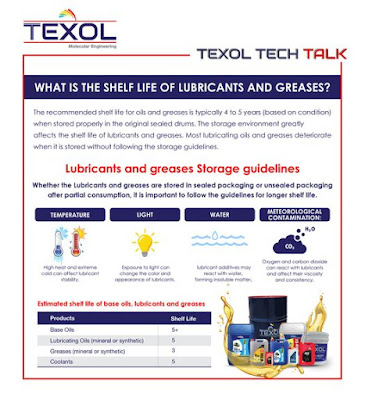
  A product’s shelf life is described as “the amount of time a commodity may be stored until it becomes unfit for use, consumption, or sale.” It’s important to remember that manufacturers assess a product’s shelf life based on normal usage and storage expectations. When handled properly in their initial sealed containers, oils and greases have a five-year shelf life. If recommended recommendations are not followed, the estimated shelf life can be shortened. The majority of products, including lubricating greases, degrade over time. The degree of oxidation of lubricating greases is highly dependent on storage conditions. A lubricating grease’s shelf life can be extremely long if stored properly. Storage Tips : Lubricants may change their appearance and/or color when exposed to light, so keep them in a dark place. Water penetration in sealed, opaque containers may encourage microbial growth and affect certain additives, resulting in the formation of insoluble material. Never store in...

Differences Between Automotive and Industrial Greases

Image
  All machinery and equipment that have moving parts require lubrication. Oils and greases are the most common lubricants that are used worldwide. With increasing complexities within machinery structures, the requirement of lubricants and oils becomes more specific and stringent. Industrial and automotive grease components can be very similar; the choice of grease may depend on the desired application and efficiency. In conclusion, there really isn’t any difference between automotive grease and industrial grease. However, the selection of the grease is based on the application and output required. The applications of the grease depend upon the critical elements that are used in its making. These include— thickener type and concentration, lubricant type, viscosity and additive package.  Greases are classified by the National Institute of Lubricating Grease (NLGI) and range from 000 to 6. Usually, an NLGI 2 grade is the specification used in automotive greases. One of the only d...