Posts

Showing posts with the label petrochemical company

How is White mineral Oil Different from other oils?
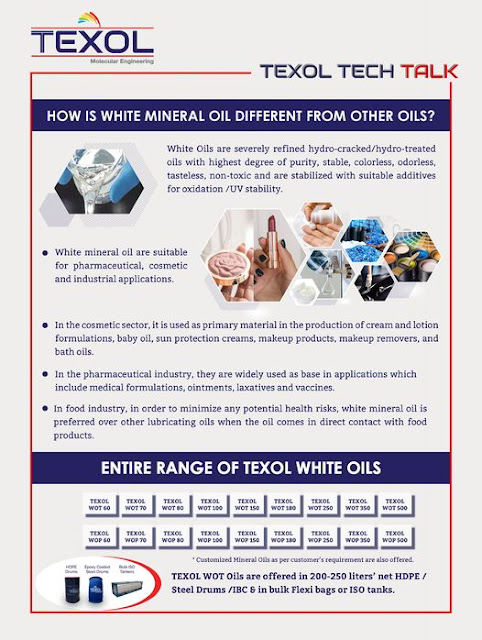
Image
  Mineral oil is a widely used ingredient in a wide range of industries, from cosmetic and personal-care manufacturing to mechanical work and engineering. The term "mineral oil" is frequently used in a broad sense, referring to a variety of petroleum-based oils. The refining process produces mineral oil. White mineral oil is a highly refined petroleum mineral oil composed of a complex mixture of hydrocarbons obtained through intensive treatment of a petroleum fraction with sulfuric acid and oleum, hydrogenation, or a combination of hydrogenation and acid treatment. Engine oils are available in a range of grades, viscosities, and additives. It is difficult to decide whether to buy mineral oil or synthetic oil for the engine. In general, conventional oil outperforms mineral oil in areas such as vehicle protection and lubrication addition. Whereas, white mineral oils are used in a variety of applications across a wide range of industries. White mineral oil is also referred to as...

How Petrochemicals Are Used in Manufacturing?

Image
  Petrochemicals are a bunch of synthetic mixes that fuel a wide cluster of items across the globe. They are made of hydrocarbons that are isolated and removed from oil (unrefined petroleum) and flammable gas and are at the center of numerous ventures. It’s imperative to take note that the greatest worry about petroleum derivative use is from burning, transforming these hydrocarbons into carbon dioxide and water. So while there are ecological worries about the petrochemical assembling of plastics, it doesn’t prompt a huge arrival of ozone-depleting substances that can cause environmental change. For instance, the plastic assembling is catching the carbon in an idle structure (the plastic) and not delivering it to the climate. A feedstock is a crude material that is utilized to make a valuable item in a mechanical cycle. Flammable gas fluids and naphtha that is made from raw petroleum during the refining cycle are utilized as feedstock to make a wide assortment of petrochemicals, by...

Understanding Automotive oil

Image
  Automotive oil is a base oil that is enhanced with various additives particularly antiwear additives, detergents, dispersants, and, for multi-grade oils, viscosity index improvers. Automotive oil is ideally used for the lubrication of internal combustion engines.  Automotive oil levels need to be checked on a regular basis. Even if you have a new car, and you take it for servicing, you still need to check your car’s oil level. Usually, the older your car engine, the more oil it will tend to use (or leak) and the more often you need to check the dipstick to make sure it stays above the minimum level. It is crucial that one maintains the car’s minimum oil level, otherwise key engine components will be starved of oil and either wear prematurely or fail catastrophically. Which could result in a lot of expense and trouble—far more than the cost of a quick oil change at the gas station.  However, keeping your oil topped up is not the only thing to check, constant mechanical a...

Industrial Gases in Petrochemical Processing

Image
  Chemicals derived from petroleum or natural gas are known as petrochemicals which are typically extracted during the refining process as crude oil and natural gas liquids are cracked or distilled.  Chemical plants convert oil, natural gas, air, water, metals, and minerals into chemical products. They produce many important building blocks for industry processes, including ethylene, propylene, butadiene, and aromatics. Oil refineries produce olefins and aromatics by fluid catalytic cracking of petroleum fractions. Olefins and aromatics are the basic components for a wide range of materials such as solvents, detergents, and adhesives. Olefins are the basis for polymers and oligomers used in plastics, resins, fibers, elastomers, lubricants, and gels.  In any refinery, the reliability of rotating equipment is crucial to efficient, cost-effective production. This includes, for example, gas and air compressors, ball valves, centrifugal pumps, mechanical seals, gearboxes and s...

What is fuel dilution and why is it bad?

Image
What is Fuel Dilution? Have you wondered too? Well, it is what occurs when gasoline or diesel fuel enter your engine’s crankcase and dilute the motor oil. How does this happen though? This actually happens because of a number of factors like loads of idle time for the machine, incomplete combustion, low engine temperatures, frequent short trips or dirty fuel injectors. It’s not limited to this but these could be the probable reasons for fuel dilation to occur. It needs to be known that certain machines are prone to this dilation if kept idle for a long time. Fuel dilation is not good for the machine and here is where you need to understand that oils and raw materials must be purchased from trusted lubricant manufacturers, because here the quality of the lubricants and oils matter the most.  Why else is Fuel Dilation bad? Well, it causes problems in the injection system leading to poor combustion in the engine. Apart from this, the machinery will not perfor...